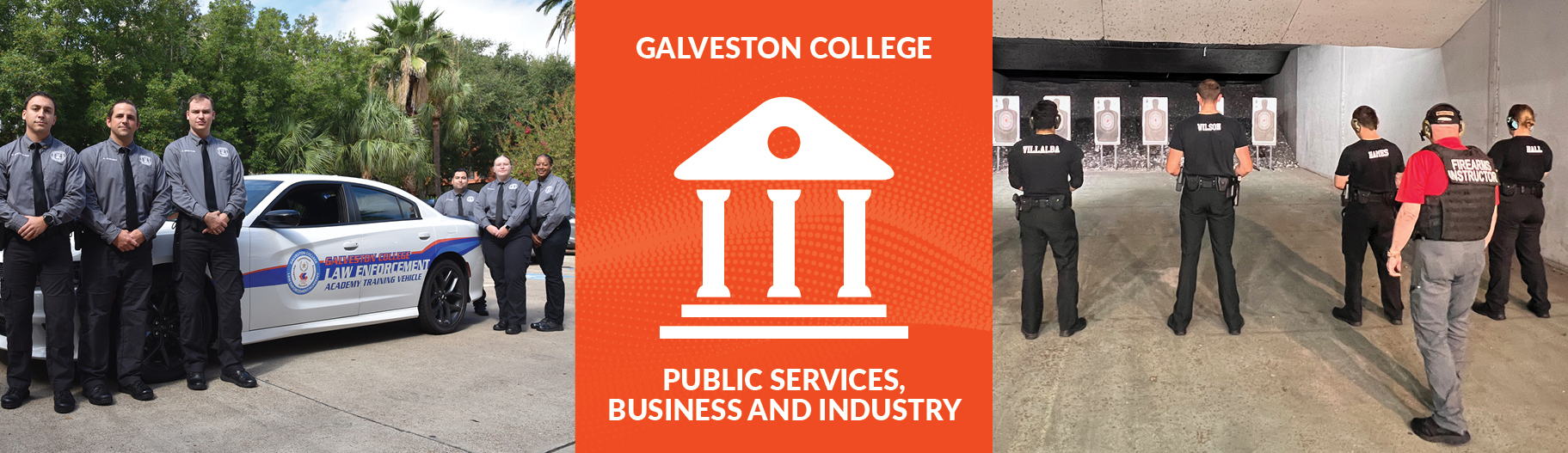
Law Enforcement Academy
Galveston College’s Law Enforcement Academy has been placed on at-risk probationary status by the Texas Commission on Law Enforcement (TCOLE), effective October 2, 2026, for a minimum period of one year. During this period, the College will continue working to address the findings identified during the TCOLE evaluation, strengthen internal procedures, and ensure ongoing compliance with applicable TCOLE requirements.
Galveston College is committed to maintaining the quality and integrity of its law enforcement training programs and will continue to work collaboratively with TCOLE, students, and sponsoring agencies throughout the probationary period.
Law enforcement professionals serve a vital role in society by preventing and controlling crime, protecting the public, providing detention and rehabilitation services, and upholding equal justice through the judicial system.
The mission of the Galveston College Law Enforcement Academy is to prepare students—mentally, morally, and physically—to enter field training and effectively assume the duties and responsibilities of a peace officer. The Academy is committed to developing ethical, competent, and community-focused law enforcement officers.
In fulfilling this mission, the Academy aligns with and supports the goals and standards of the Texas Commission on Law Enforcement (TCOLE) and Galveston College.
Overview
- Associate of Applied Science (AAS) - Law Enforcement (Full Time)
- Associate of Applied Science (AAS) - Law Enforcement (Part Time)
- Certificate - Law Enforcement - Level One
See the full college catalog for additional information and course descriptions.
The Galveston College Law Enforcement Academy offers a full-time and part-time academy for individuals who are seeking their Texas Commission on Law Enforcement (TCOLE) basic peace officers license.
The basic academy program involves 736 hours of classroom and hands-on training. This course is available to police departments sending recruits, or individual applicants. Completion of this training allows individuals to take the TCOLE licensing examination to become a licensed Texas Peace Officer.
All prospective students can obtain a Law Enforcement Academy application emailed to them by submitting a request under the Program Application tab.
Successful applicants will be notified by email of acceptance to the program.
For acceptance to the Galveston College Law Enforcement Academy individuals (hired cadets or individual applicants) must meet the most current standards as established under the Texas Administrative Code, Title 37, Part 7, Chapter 213, Rule 217.1, Minimum Standards for Enrollment and Licensure.
All applicants must meet Galveston College’s current enrollment requirements.
Basic qualifications for admittance, each prospective student must meet the following criteria:
- High school graduate, GED, or 12 hours from an accredited college
- 21 years of age at the time of licensure
- No felony convictions
- No convictions of a Class B misdemeanor or above within the last ten (10) years
- No family violence convictions
- Pass a drug test, psychological screening, physical, and background check
- U.S. citizen or is a legal permanent resident of the United States, if the person is an honorably discharged veteran of the armed forces of the United States with at least two years of service before discharge and presents evidence satisfactory to the commission that the person has applied for United States citizenship.
The basic academy program is available to individuals who meet admission standards and are accepted for attendance. Attendees must be prepared for a demanding program. The process is mentally and physically challenging. There are significant time demands both in and out of the classroom. But the rewards are high for those who are capable of the challenge. Policing is an honorable profession. Service to others is a high calling, one that few are willing to accept in their lives.
Upon successful completion of the program, you will receive 22 college credits and be qualified to sit for the state licensing exam. After passing the exam you will be certified by the State of Texas to obtain employment as a peace officer.
Still interested?
Training Coordinators should contact the Academy Director directly. If you are applying as an independent applicant, your first step is to go to the Program Application tab and click on the request button.
- General – All Applicants
- For acceptance to the Galveston College Law Enforcement Academy individuals (hired cadets or individual applicants) must meet the most current standards as established under the Texas Administrative Code, Title 37, Part 7, Chapter 213, Rule 217.1, Minimum Standards for Enrollment and Licensure.
- All applicants must meet Galveston College's current enrollment requirements.
- Individual Applicants
- Automatic disqualifiers for individual applicants include anything that would exclude the applicant from meeting the most current standards as established under the Texas Administrative Code, Title 37,Part 7, Chapter 213, Rule 217.1, Minimum Standards for Enrollment and Licensure.
- Other factors that will be considered prior to acceptance into the Galveston College
Law Enforcement Academy include, but are not limited to:
- Any pending litigation-criminal or civil (including divorce)
- Evidence of good character and having a stable school, work and driving record
- Reputation of the individual with schoolmates, work associates, coaches, teachers, etc.
- The law enforcement academy coordinator shall make the final determination in allowing a cadet to enter the academy program.
- Enrollment
- Upon approval to attend a police academy class, applicants must complete all required Galveston College enrollment processes.
- Applicants are responsible for obtaining and displaying motor vehicle parking permits on campus and for complying with regulations for parking, paying traffic fines, and obeying speed limits.
- Applicants are responsible for prompt payment of all financial obligations to the College.
- Disabilities
- Any cadet who has a disability or who claims a disability according to the rules of the Americans with Disabilities Act must notify Galveston College (Student Services) of the disability in sufficient time to allow the Academy to make necessary accommodations consistent with the ADA prior to the commencement of classes.
- Failure to notify the Academy in a timely manner will result in a delay of acceptance into an Academy basic program until the following basic program.
- It is the cadet’s responsibility to inform the Academy of a disability requiring accommodations.
Employment opportunities for both men and women have never been better. The need is critical.
Texas Employment Trends - Police and Sheriff's Patrol Officers
📊 Employment Growth in Texas
- 2020 Employment: ~58,020 police and sheriff’s patrol officers
- 2030 Projected Employment: ~65,470
- Growth Rate: 13% increase over the decade
- Annual Job Openings: ~5,420 projected per year
📉 Recruitment Challenges
- Application Decline: Agencies report a 40% drop in applications since 2019 [respondcapture.com]
- Vacancy Rates: Departments are operating with 10–15% vacancies, with some cities facing up to 25% shortfalls
- Attrition: Early-career departures are rising, with 9.8% annual attrition in 2024
🧭 Retention Strategies
- Policy Changes: 75% of agencies have adjusted policies to attract candidates, including:
- Loosening grooming standards
- Increasing salaries and bonuses
- Streamlining hiring processes
- Legislation: Texas Senate Bill 2144 (2025) allows peace officers to take on additional roles without extra licensing, aiming to improve flexibility and retention
Next Steps

Start the convenient online application process using the link below
Career Coach is a FREE online tool designed to help you find a great career by providing the most current local data on wages, employment, job postings, and associated education and training.
Through a simple keyword search, you can learn about the employment prospects of differing careers. The real-time information is customized to the College’s geographic region and includes detailed wage estimates and up-to-date job postings associated with any career. Users are directed to the College’s programs when searching for specific jobs.
Career Coach also includes a built-in resume builder to help students and jobseekers quickly put together an updated resume with key skills and previous job experiences.
Financial aid is available to help eligible part-time and full-time students pay for college. It can be a combination of grants, loans and work-study.
To learn more about the types of scholarships and their deadlines, please click on the “Learn More” link below.
| Name | Sharon Pagan |
| Ext | 409-944-1410 |
| [email protected] | |
| Room | AT-304 |
| Schedule an Appointment | Appointment |
Questions? Contact Us.
Hours of Operation
Monday-Friday
8:00 A.M. - 5 P.M.
[email protected]
409-944-4242
409-944-1500